
Atsign EdgeAI
Connect your edge
without exposure.
Secure connectivity and integrated control for Edge AI, physical AI, and IoT deployments across customer sites, remote locations, and changing networks.
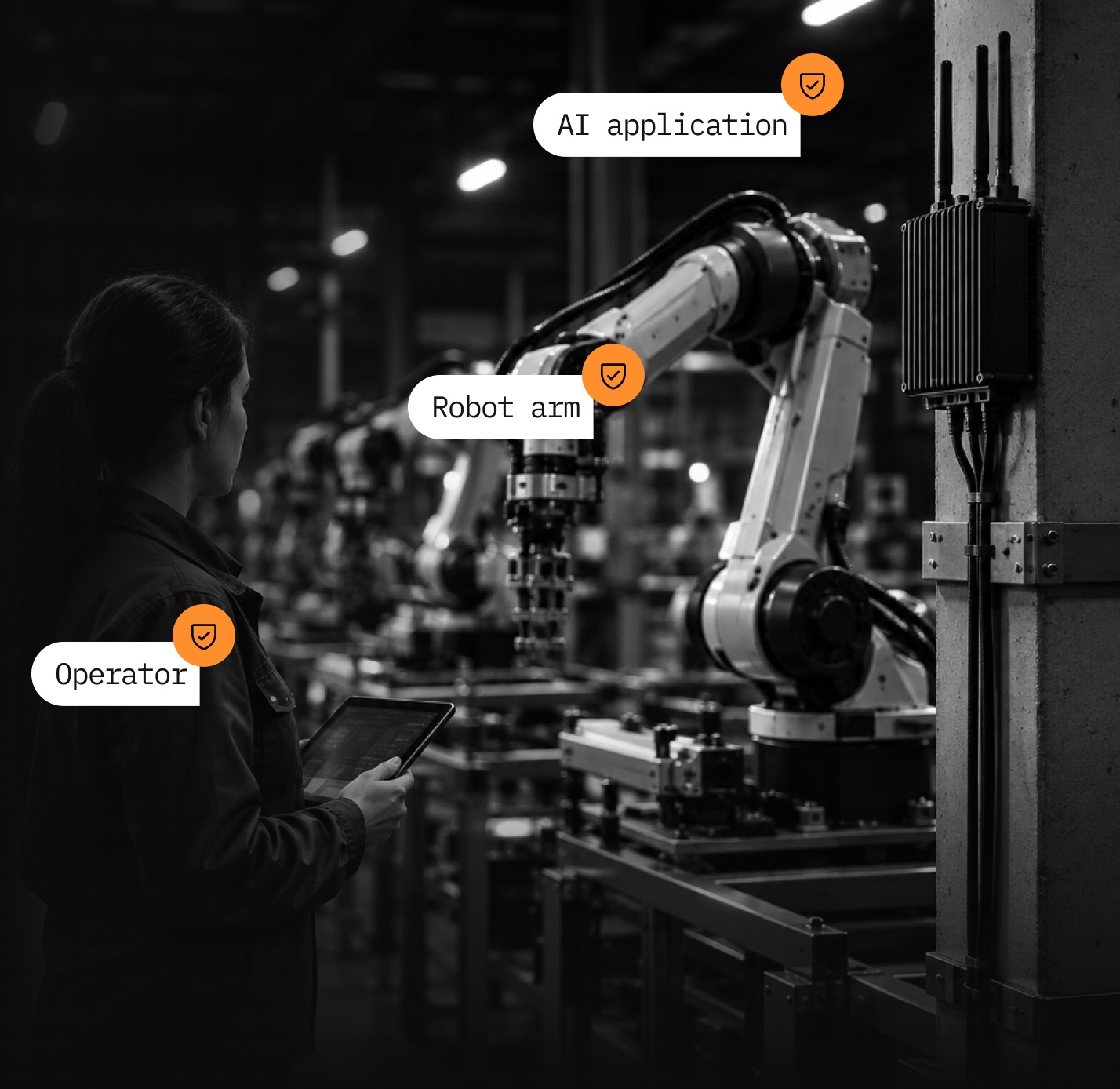
Endpoint software. Integrated management. One offering.
Atsign EdgeAI combines endpoint software with an integrated control center to securely connect and control devices, gateways, applications, and operational systems across networks.
Reduce security exposure
Keep protected services out of public reach and restrict compromised devices, applications, and agents.
Deploy faster
Reduce the site-specific network changes that delay production.
Lower deployment and operating costs
Reduce custom network engineering and ongoing administration across sites.
Endpoint software
Securely connect devices and applications across networks and control which systems they can communicate with. Communication permissions remain independent of network addresses and locations, helping you maintain consistent control as deployments move or expand.
Integrated control center
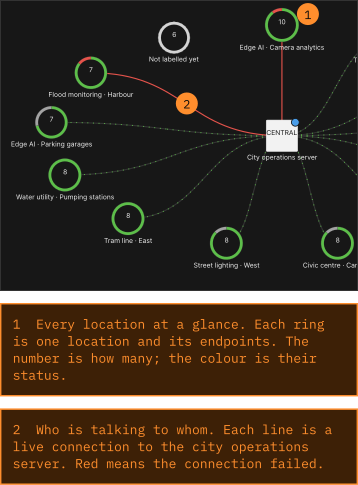
See which systems are connected and manage which systems can communicate from one place. When a device, application, or agent is compromised, use a granular Kill Switch to quarantine it or restrict specific connections, helping contain the threat with less disruption to other systems.
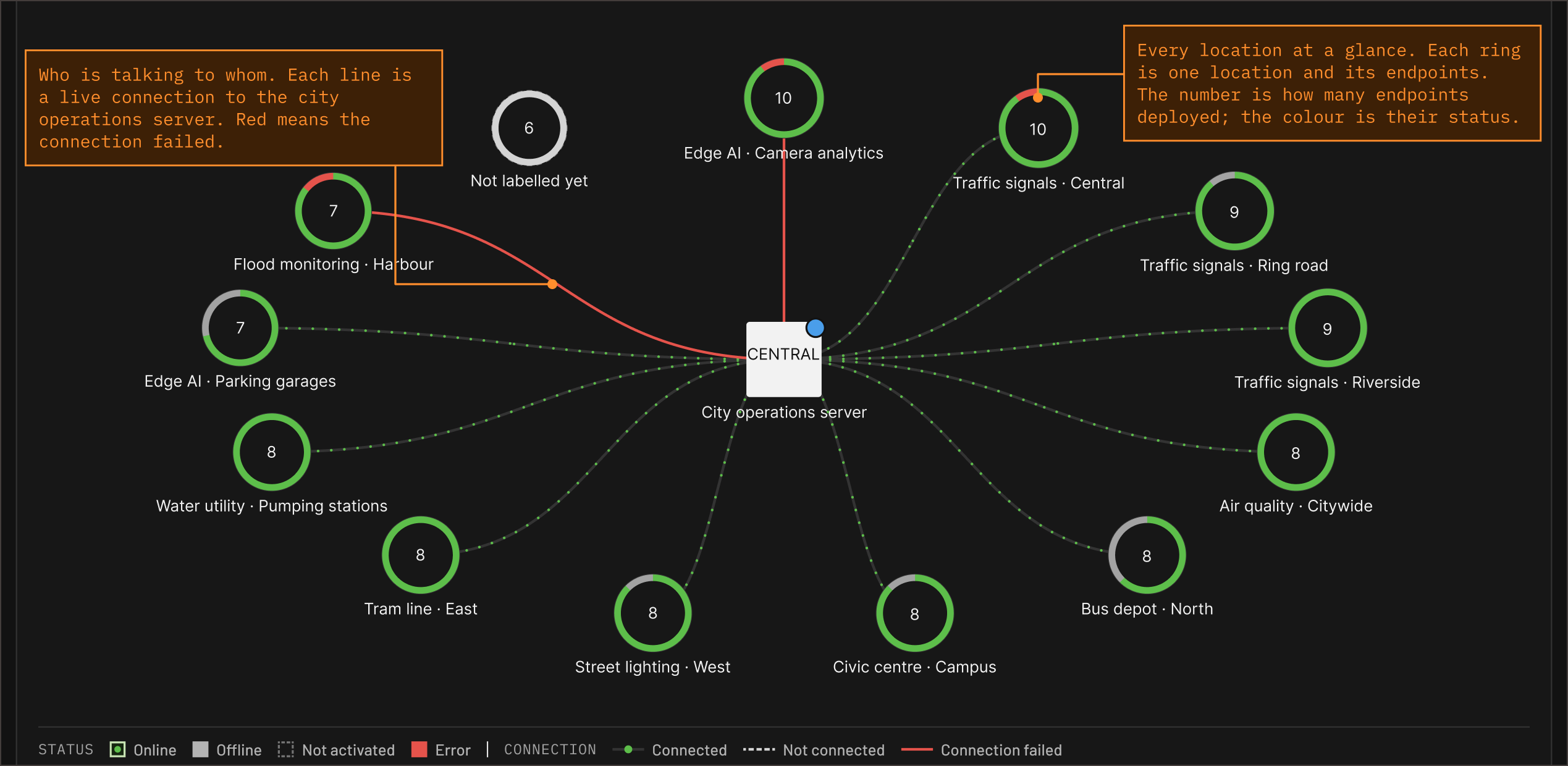
A repeatable approach to deployment.
Customer networks, cellular connections, cloud environments, and remote sites introduce different constraints. Atsign EdgeAI provides a consistent connectivity model across those environments.
[01]
Deploy endpoint software.
Add endpoint software to the participating devices, gateways, applications, or edge systems.
[02]
Set secure connection policies.
Define which systems can communicate with which protected resources. Each participating system receives a cryptographic identity, allowing those permissions to remain consistent when its IP address or network location changes.
[03]
Your systems establish outbound-only connections.
Connect across available networks without opening inbound listening ports on protected systems or requiring fixed public IP addresses.
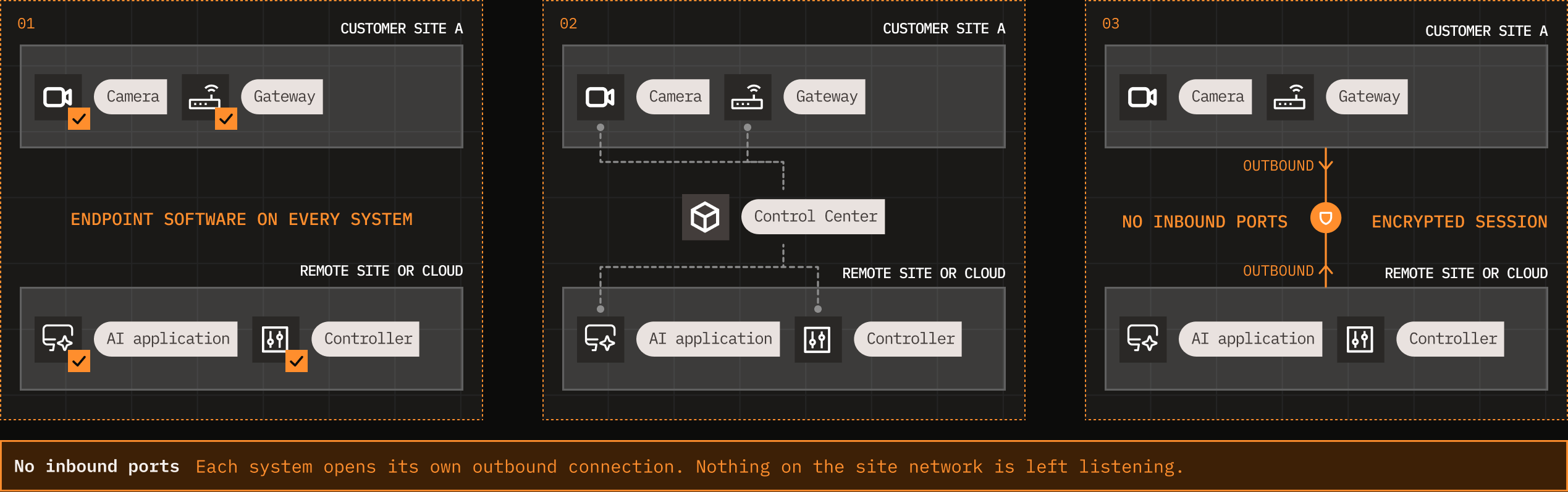
This reduces dependence on site-specific inbound firewall changes, VPN provisioning, and network redesign. Teams can spend less time coordinating network work and move from pilot to repeatable production faster.
See what’s connected. Decide what can communicate.
As deployments expand, teams need a consistent way to manage access across devices, applications, sites, and operating environments.
Through the integrated control center, authorized teams can:
See protected systems and which systems they can communicate with
Organize devices and systems into sites, groups, and collections for easier management
Define and update communication policies
Restrict or revoke communication authority as requirements and risks change
Apply policies to individual systems and their connections without first changing multiple network systems.
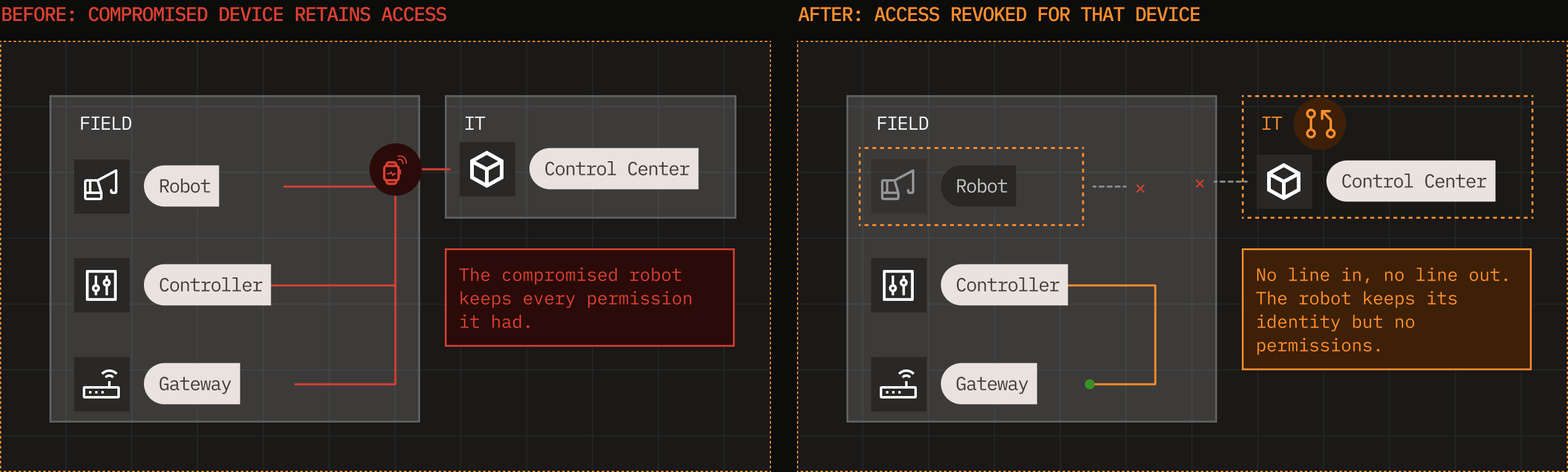
Contain compromised systems without network-wide changes
An authorized device, application, or AI agent can still become compromised or behave unexpectedly. Atsign EdgeAI’s granular Kill Switch lets teams restrict or revoke its communication permissions:

Quarantine
Isolate a compromised or misbehaving device, application, or agent.

Revoke
Remove its communication authority.

Restrict
Preserve only specifically approved communication relationships.
Manage the response through the control center without waiting for coordinated firewall, routing, or switching changes.
Security and performance, demonstrated with Intel.
Atsign and Intel co-engineered a smart transportation solution that combines secure agent communication with Intel hardware security and cryptographic acceleration.
Joint solution brief / Atsign and Intel
Atsign EdgeAI
88×
cryptographic throughput uplift
48 ms
key provisioning
Explore the architecture, transportation application, and performance findings in the joint solution brief.
Read the joint solution briefIs EdgeAI right for your deployment?
Atsign EdgeAI is designed for organizations connecting distributed systems across environments they may not own or control.
For enterprises operating distributed environments
Connect devices, applications, and AI agents across facilities, field locations, and remote sites, with control over which systems can communicate.
For manufacturers and connected-product providers
Bring secure connectivity and communication control into products deployed across customer environments. Reduce the networking work required to expand across an installed base.
Applications include:

Edge AI
Securely connect local models, data sources, and applications, keeping communications private and limiting access to authorized systems.

Physical AI and robotics
Securely connect robots, controllers, and supporting applications, with precise control over which systems can communicate.

Smart cities and transportation
Securely connect roadside infrastructure, sensors, vehicles, and edge systems without publicly exposed inbound services.
IoT, OT, and critical infrastructure
Securely connect gateways, operational applications, and remote equipment with consistent communication policies across cellular and constrained networks.
Questions about architecture and fit.
What does our environment need to support?
Atsign EdgeAI runs on Linux, Windows, and macOS systems, including supported ARM-based edge devices and OpenWrt gateways.
Your systems need IP connectivity and outbound TCP access to the required Atsign services. They can operate behind NAT or carrier-grade NAT without open inbound ports, port forwarding, or static public IP addresses. Networks that restrict outbound connections may require allowlisting.
The endpoint software runs on your existing systems alongside the applications and services you want to connect.
How are communications and private keys protected?
Communications are encrypted end to end between authorized devices and applications. The private keys needed to decrypt the data remain with the communicating systems, rather than being held by Atsign or a network intermediary.
Atsign EdgeAI supports cryptographic agility, allowing cryptographic algorithms to be updated as standards and threats evolve. It also supports post-quantum cryptography to help protect sensitive communications against future quantum-computing threats.
Together, these capabilities help protect long-lived deployments as security requirements change.
How does EdgeAI help with compromised AI agents?
Explicit communication policies limit which protected resources an agent can reach. If the agent is compromised, teams can restrict or revoke its communication authority.
For risks such as prompt injection, these controls help constrain the resulting communication and contain the impact. They do not detect malicious prompts or determine whether an agent’s reasoning is correct.
Is EdgeAI only for AI workloads?
No. It also supports IoT, OT, connected devices, and other distributed operational systems. Atsign EdgeAI provides connectivity and control; it does not supply AI models or compute infrastructure.
What if we’re building a custom application?
Atsign SDKs and AI Architect provide a path for embedding Atsign Platform capabilities into applications, devices, and agents.
Let’s work through your deployment.
Tell us what you’re connecting, where it needs to operate, and what’s slowing you down.
We’ll review your requirements, demonstrate the relevant EdgeAI capabilities, and discuss whether a focused proof of concept makes sense.
Building a custom application or AI agent?
AI Architect helps you map components, permissions, and communication paths, then turns that blueprint into a structured prompt for your AI coding assistant.


