
Eliminate healthcare attack surfaces
Secure clinical systems, IoMT, connected medical devices, and AI workflows with verified identity, bounded authority, end-to-end encryption, and zero inbound ports.
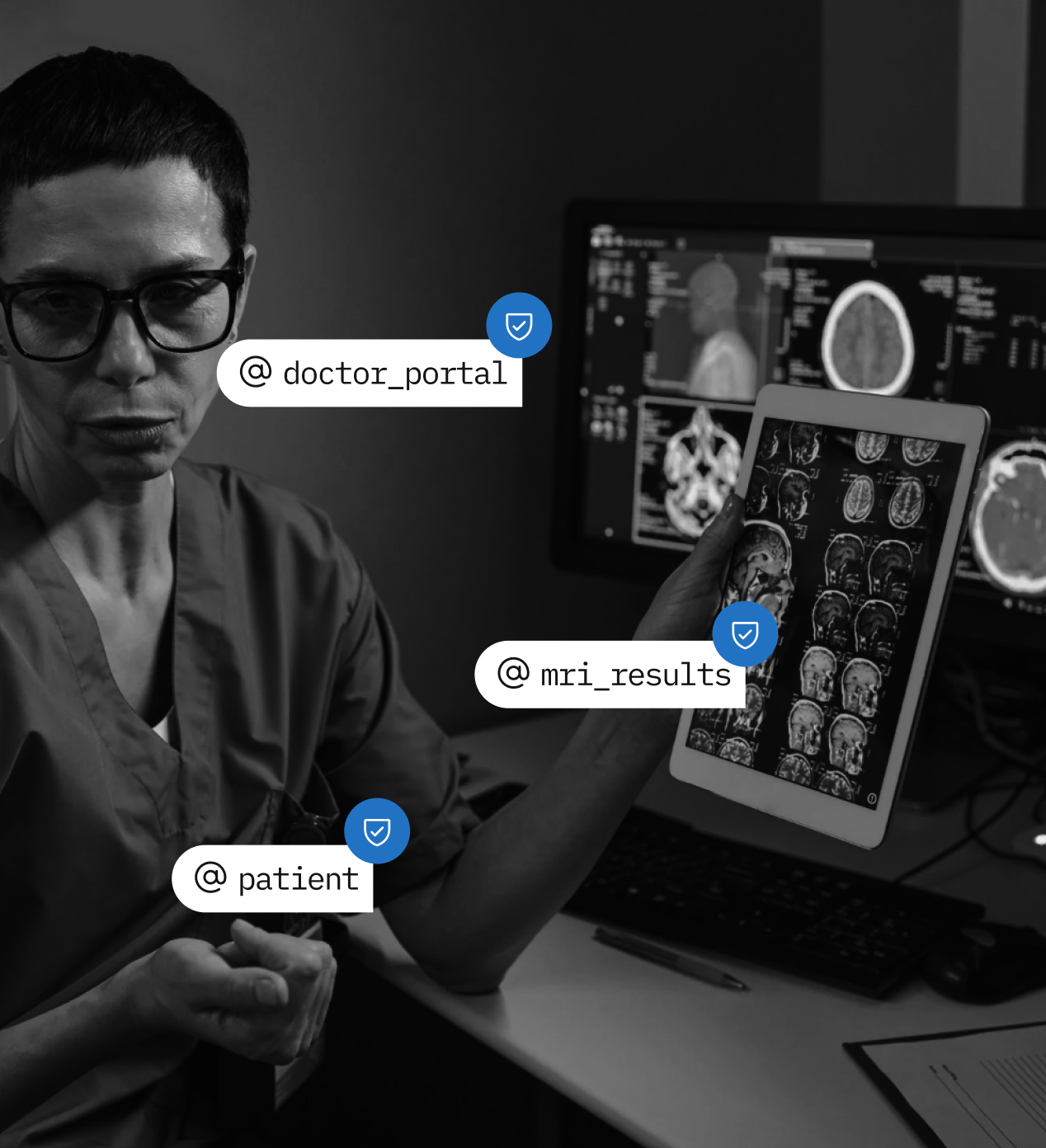
// Healthcare security now extends from the hospital to the home
PHI moves across hospitals, payers, clinicians, patients, labs, pharmacies, business associates, home-monitoring devices, applications, and AI agents. Atsign helps healthcare organizations protect those connections with verifiable identity, bounded access, and secure communication that does not depend on exposed services or broad network trust.
// Built for the modern healthcare data ecosystem

Connected medical devices and IoMT
Patient monitoring equipment, infusion pumps, imaging systems, and wearables — each a node that requires verified identity and scoped connectivity, not network-level trust.

Clinical and administrative AI
AI agents accessing clinical data, ordering systems, and documentation workflows need scoped, auditable access tied to verified identity — not broad credentials.

Provider, payer, and partner integration
EHR-to-payer data exchanges, lab integrations, and partner API connections create shared secrets at every boundary that accumulate across years and organizations.

Patient and home-edge data
Remote monitoring, home health devices, and patient-reported outcomes create data pathways that extend zero-trust requirements beyond the hospital perimeter.
// Healthcare's current connectivity model keeps recreating risk
Healthcare organizations spend enormous effort protecting PHI, reviewing third-party access, securing connected devices, managing service accounts, and preparing for compliance reviews. But shared credentials, exposed services, fragmented identity, and late-stage security decisions keep bringing the same risks back.

Connected-device exposure
Medical devices, gateways, and monitoring systems may rely on remote-access infrastructure, open inbound services, or difficult-to-patch software that expands the reachable attack surface.

AI agents inherit excessive access
Clinical and administrative agents can inherit clinician credentials or shared service accounts, blurring accountability and giving non-human actors more access than they need.

Healthcare integrations create secrets sprawl
EHRs, labs, and pharmacies depend on FHIR API keys, service accounts, brittle VPNs, and static credentials that are incredibly difficult to rotate, revoke, and audit.

Security debt slows procurement and production
AI-assisted development and frontier AI models can accelerate weak assumptions around identity, PHI access, APIs, encryption, and human oversight unless those decisions are defined before code is generated.
// Give every participant in the care ecosystem verifiable identity

Verify every participant
Patients, clinicians, applications, medical devices, services, partners, and AI agents authenticate cryptographically before communication begins.

Define access and authority
Control which PHI, systems, and actions each participant is authorized to use.

Keep keys with authorized participants
End-to-end encryption prevents infrastructure intermediaries from decrypting exchanged data.

Connect without public exposure
Enable authorized communication across hospital, cloud, partner, home, and device environments without open inbound access.
// Where Atsign creates strategic value in healthcare

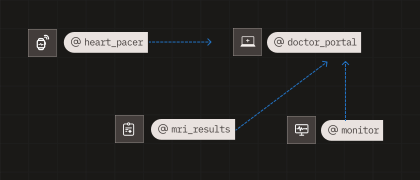
Secure connected medical devices and IoMT
Assign every medical device a cryptographic identity using an atSign. Devices authenticate directly — without requiring network-layer controls, shared credentials, or VPN access. Connectivity is scoped to authorized participants only, so a compromised device cannot move laterally through clinical infrastructure.

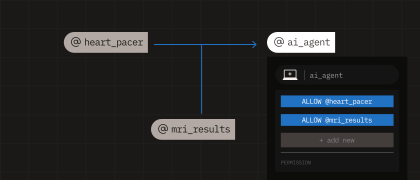
Give every clinical and administrative AI agent its own identity
AI systems in clinical workflows should have scoped, auditable access — not broad credentials. Atsign enables AI agents to operate with the minimum necessary access, tied to verified identity, with full audit trails that meet security and compliance review requirements.

Remove shared secrets from healthcare integrations
EHR integrations, lab connections, and payer APIs introduce shared secrets at every boundary. Atsign replaces those secrets with cryptographic identity and namespace-scoped access — removing the secrets sprawl that creates audit complexity and breach risk.
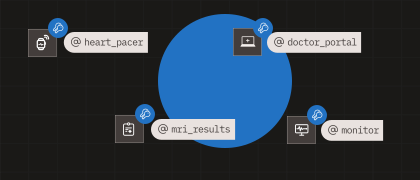

Protect patient and home-edge data exchange
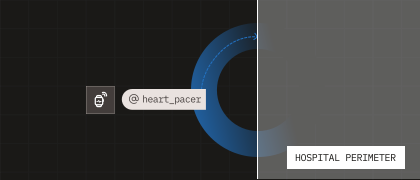
Home health devices and remote monitoring systems create data pathways outside the hospital perimeter. Atsign extends zero-trust connectivity to the edge, ensuring that patient data only flows between cryptographically verified participants — regardless of network location.
// Build new healthcare systems.
Protect what is already deployed.
Build healthcare applications and AI agents secure by design
Atsign AI Architect gives teams a secure-by-design, spec-driven workflow for defining application components, identities, authority, privileges, PHI access, policies, human approval points, data flows, and communication paths before code is generated.
The approved blueprint becomes structured context for AI coding assistants, helping teams:
Protect existing healthcare systems and devices
NoPorts secures connectivity to hospital systems, provider databases, medical devices, gateways, servers, remote monitoring infrastructure, and on-premises applications without open inbound ports or major network rearchitecture.
Authorized users, applications, devices, and support systems connect through cryptographic identity and outbound-initiated communication while protected services remain undiscoverable to public scanning.
NoPorts helps healthcare organizations:
// Reduce the cost of securing healthcare systems
Atsign helps healthcare teams reduce the overhead created by late-stage security retrofits, VPNs, firewall exceptions, shared credentials, and repeated network changes across provider, partner, device, and home-care environments. AI Architect helps teams build identity, PHI access boundaries, encryption, and governance into new healthcare applications before code is generated, while NoPorts helps protect existing clinical systems and connected devices without exposed inbound access.
Download the Healthcare brief to see how secure-by-design architecture can reduce compliance debt, accelerate deployment, and support safer AI adoption in regulated healthcare environments.

// Secure healthcare systems, proven in practice
Case study / NeuroVitals
Atsign AI Architect
4
months
Faster to secure architecture
~3
hours
Initial working prototype
100+
hours
Engineering hours saved
NeuroVitals
Building a secure, AI-assisted neurological monitoring platform with Atsign AI Architect. NeuroVitals needed a security model that could handle sensitive clinical data, connected devices, and AI workflows — without slowing down development or accumulating security debt before launch.
Read the Case study”
We got to a working prototype faster than I expected, and the security model was already in place.
— Rick Deacon, Co-Founder, NeuroVitals
// Support healthcare security and compliance requirements
Atsign helps teams design identity, authority, encryption, access boundaries, and communication controls into healthcare systems from the start.
These capabilities can support technical and operational controls relevant to:
01
HIPAA and HITECH
02
HITRUST
03
FDA Section 524B cybersecurity requirements for connected medical devices, including postmarket vulnerability monitoring and response planning
04
GDPR and privacy-by-design requirements
05
EU AI Act obligations for high-risk AI
06
Healthcare procurement and business-associate security reviews
Compliance still depends on the complete implementation, policies, evidence, processes, and operational controls.
// Start with one healthcare workflow
Begin with one clinical AI agent, connected-device path, provider integration, patient-data flow, or third-party access point. Replace shared credentials, exposed services, and brittle network trust with verified identity, bounded authority, non-custodial encryption, and no exposed inbound access.


