
Secure financial systems without exposed infrastructure
Protect banking apps, payment flows, partner services, internal systems, and AI workflows with verified identity, bounded authority, end-to-end encryption, and no exposed inbound access.
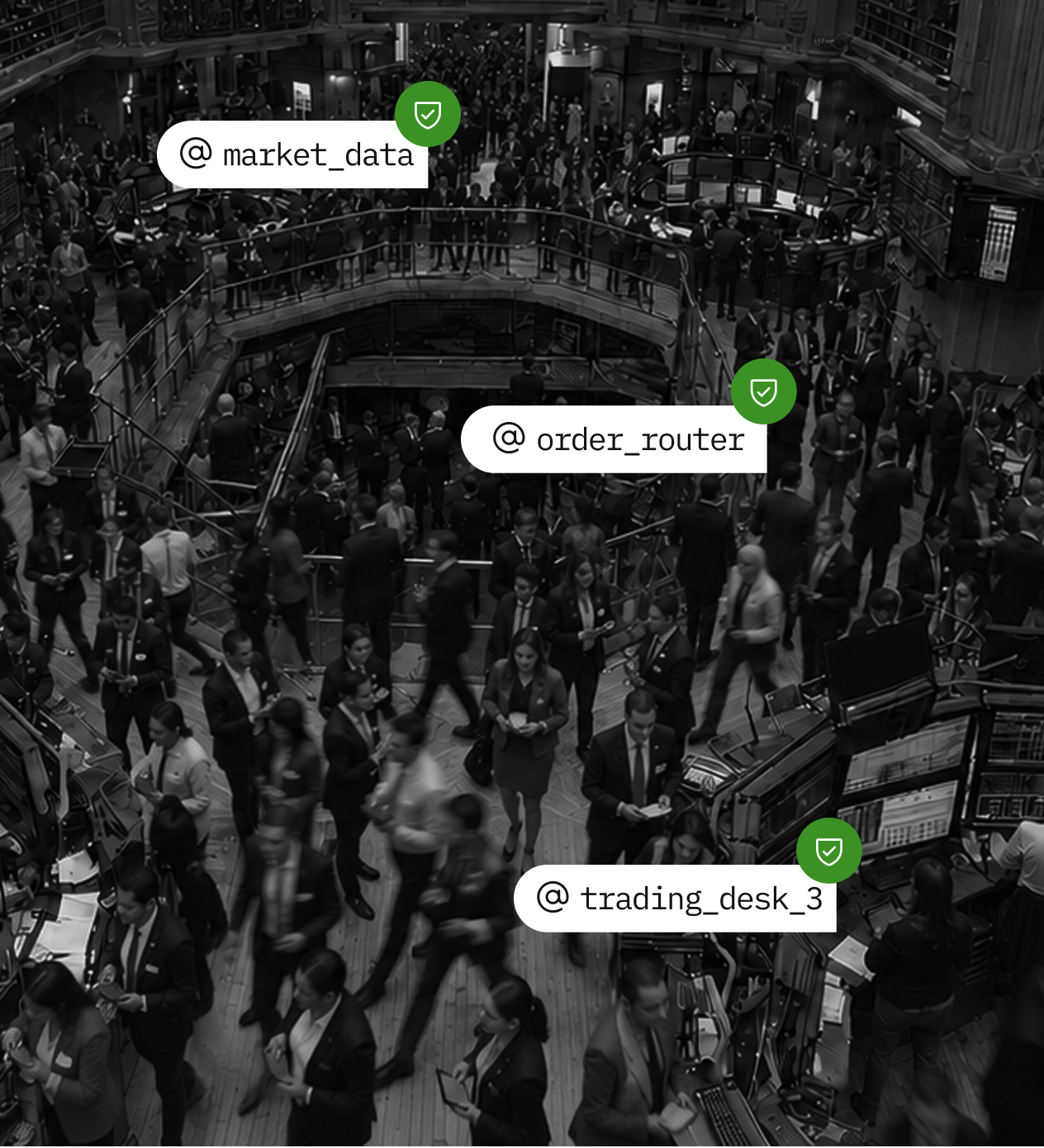
// Financial services need a new trust model
Financial institutions run on machine-to-machine communication, service accounts, API keys, privileged access, automation, and autonomous AI agents. When those interactions depend on standing shared credentials and publicly reachable services, the architecture continuously recreates exposure, identity ambiguity, and secrets-management overhead. Atsign helps make banking apps, APIs, partner services, internal systems, and AI agents reachable only to verified participants, without relying on shared credentials or publicly exposed infrastructure.
// Built for financial services ecosystems

Banking and institutional systems
Protect core services, branch systems, privileged access, institutional connectivity, and internal applications without exposing sensitive infrastructure.

Payments and treasury
Secure payment infrastructure, treasury operations, reconciliation workflows, automation, and sensitive transaction data exchange between authorized systems.

Insurance
Control access across claims, underwriting, partner data exchange, reinsurer workflows, adjusters, providers, and long-lived policyholder relationships.

Open banking, fintech, and BaaS
Secure APIs, partner services, and third-party integrations, including Open Banking APIs, with verified identity, scoped authority, and no unnecessary exposed inbound infrastructure.
// Standing credentials and exposed connectivity keep recreating risk
Financial institutions spend enormous effort scanning for leaked secrets, rotating credentials, managing privileged access, reconfiguring partner connectivity, and protecting publicly reachable services. But standing credentials, shared identities, and exposed connectivity keep recreating the same risks.

Standing credential sprawl
Service accounts, API keys, batch jobs, automations, and privileged-access tools create long-lived secrets that are difficult to inventory, rotate, and revoke.

Ambiguous machine identity
Applications, automations, and AI agents often inherit human accounts or shared service identities, obscuring who or what performed an action.

Exposed third-party connectivity
Partner integrations, vendor access, and open-banking services often depend on VPNs, gateways, firewall exceptions, and reachable endpoints that expand the attack surface and slow onboarding.

Security debt at machine speed
AI-assisted development and frontier AI models can rapidly reproduce or exploit weak assumptions around identity, authority, secrets, APIs, and encryption unless those decisions are defined before code is generated.
// Atsign makes verified identity the trust boundary

KYC-style verification for AI agents and digital participants
AI agents, users, banking apps, APIs, internal systems, partner services, and machines authenticate cryptographically before communication begins, so access is tied to a verifiable identity rather than a shared credential.

Access and authority are explicit
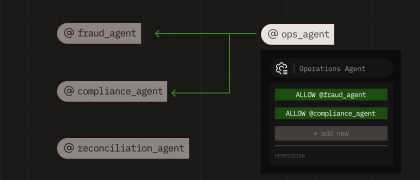
Organizations define what each participant can reach, which data it can access, and what actions it may take.

Keys remain under participant control
Communication is end-to-end encrypted with non-custodial keys that infrastructure intermediaries cannot use to decrypt exchanged data.

Protected services are not publicly exposed
Banking apps, APIs, internal systems, partner services, and operational infrastructure remain reachable to authorized participants without open inbound access for the protected connection.
// Where Atsign creates strategic value in financial services

Verifiable identity for AI agents and automations
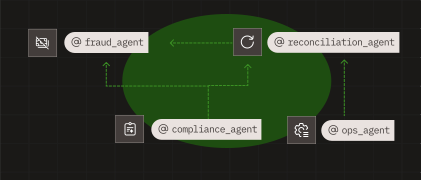
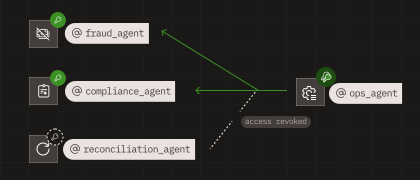
Financial institutions are deploying AI agents for fraud investigation, compliance, software delivery, reconciliation, and operational decisions. Atsign gives each agent its own verifiable identity and scoped authority instead of a human account or shared service credential, making access independently attributable and revocable.

Remove shared standing secrets from financial workflows
Core systems, payment infrastructure, batch jobs, APIs, and automation often rely on long-lived service credentials and shared secrets. Atsign replaces those patterns with participant-specific cryptographic identity and non-custodial keys, reducing credential reuse, secrets sprawl, and audit burden.

Connect partners without exposing infrastructure
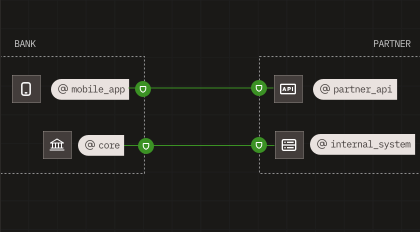
Banks and insurers depend on fintech partners, BaaS providers, institutional clients, branches, reinsurers, service providers, and external operators. Atsign enables each partner to reach only the service it is authorized to use without open inbound ports, brittle VPNs, broad network access, or endless firewall projects. Partner onboarding becomes an identity and authority decision instead of a network reconfiguration exercise.

Exchange sensitive data without surrendering control
Atsign enables identity-scoped, end-to-end encrypted exchange across mobile apps, banking services, partner APIs, internal systems, and cross-organization workflows while keeping access and key control with the communicating parties. Sensitive data can move without exposing adjacent systems or placing plaintext in the custody of the communications layer.
// Build securely. Protect what already exists
Build financial applications and AI agents secure by design
Atsign AI Architect gives teams a secure-by-design, spec-driven workflow for defining application components, identities, authority, privileges, policies, data flows, human approval points, and communication paths before code is generated.
The approved blueprint becomes structured context for AI coding assistants, helping teams:
Protect existing financial infrastructure
NoPorts secures connectivity to servers, databases, branch systems, internal tools, partner environments, and operational infrastructure without open inbound ports or major network rearchitecture.
Authorized users, applications, and systems connect through cryptographic identity and outbound-initiated communication while protected services remain undiscoverable to unauthenticated scanners.
NoPorts helps financial institutions:
// Reduce the cost of securing financial systems
Atsign helps financial institutions reduce the overhead created by shared credentials, VPNs, firewall exceptions, partner-access projects, and late-stage security retrofits. AI Architect helps teams design identity, authority, encryption, and governance into new financial applications and agentic workflows before code is generated. NoPorts helps protect existing systems while reducing network-change overhead and exposed-access patterns.
Read the brief
// Proof in practice: From idea to governed agentic
application in two days
Case Study / Corporate Governance
Atsign AI Architect
2 days
From idea to governed agentic application
A corporate governance founder used Atsign AI Architect and Claude to build a functioning multi-agent governance application in two days.
While this is a corporate governance application rather than a banking deployment, it demonstrates the identity, authority, human approval, and secure communications model required for regulated agentic workflows.
The application combined cryptographic identity, human approval boundaries, end-to-end encrypted communication, and no open inbound ports to support voting, compliance review, document generation, and executive decision-making.
The project demonstrates how Atsign can support:
→
verifiable identities for people and AI agents
→
explicit authority and human approval boundaries
→
non-custodial encrypted communication
→
reviewable governance workflows
→
faster secure-by-design application development
These capabilities can support technical and operational controls relevant to SOC 2, PCI DSS, and the EU Digital Operational Resilience Act.
Relevant frameworks
SOC 2
PCI DSS
DORA
Compliance still depends on the complete implementation, policies, evidence, processes, and operational controls.
// Change the trust model without rebuilding the bank
Start with one agent fleet, machine-to-machine workflow, partner connection, or privileged-access path. Replace standing shared credentials, exposed infrastructure, and brittle network trust with verified identity, bounded authority, and non-custodial encryption.


